Projects
Selected research and engineering projects, in reverse chronological order.
 2026.03
OCRGate: OCR + VLM-Based Financial Document Verification System
Built an automated document verification pipeline that combines OCR, rule-based validation, and selective VLM fallback for robust financial document processing.
Details
Role
- Designed a 4-stage validation pipeline for document classification, field verification, and quality assessment.
- Developed an OCR-first + selective VLM fallback framework using PaddleOCR, Qwen-VL, and confidence-based routing.
- Built an end-to-end service with FastAPI, SSE streaming, and a web-based review interface for real-time document inspection.
Results
- Reduced manual review requests by 39% using confidence-based OCR–VLM routing.
- Achieved a 94.7% Safe Pass Rate.
 2025.01 – present
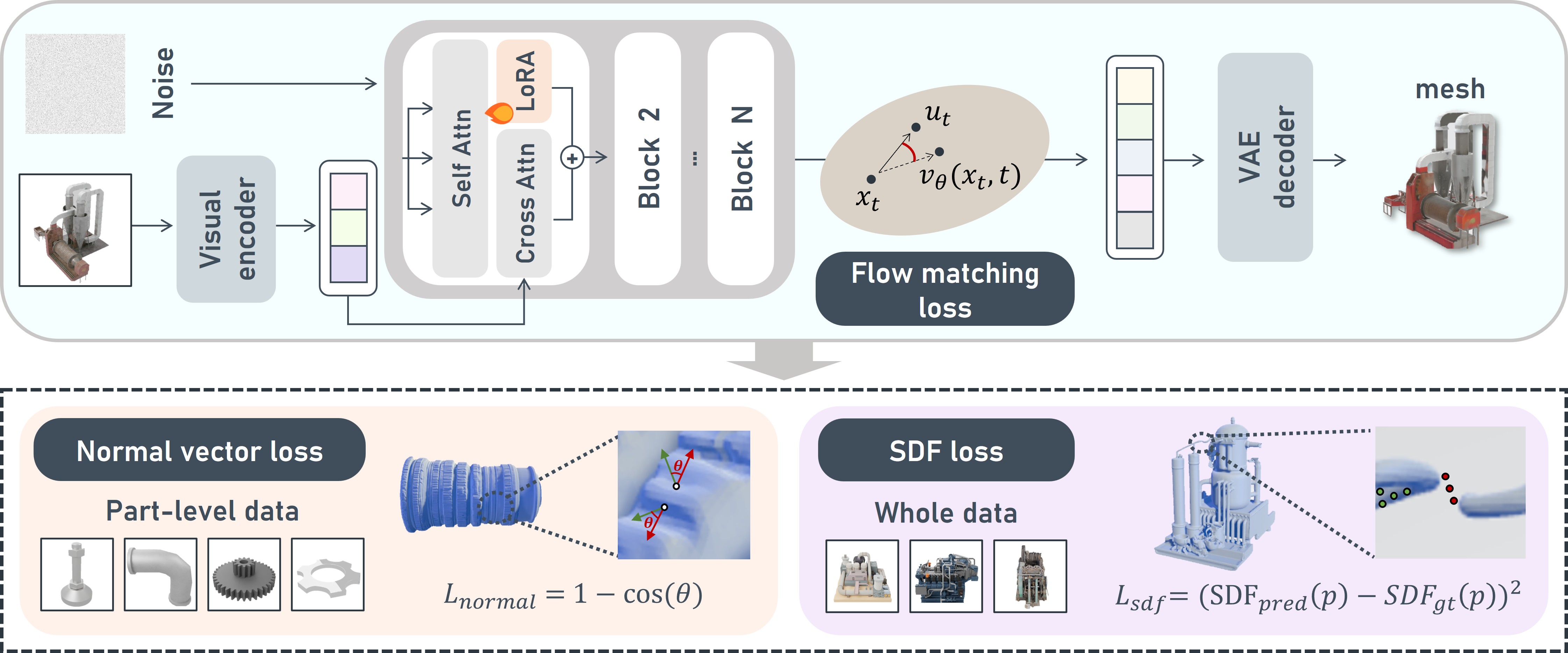
Fine-Tuning Hunyuan3D 2.1 for Industrial Plant Domain
Build a domain-specialized image-to-3D generation model tailored for industrial plant environments, where complex mechanical structures require higher geometric accuracy and visual consistency compared to generic pretrained models.
Details
Role
- Led geometry-aware fine-tuning of Hunyuan3D for industrial image-to-3D generation, addressing structural defects, topology failures, and reconstruction artifacts.
- Designed a two-stage supervision framework combining surface normal alignment and SDF-based geometric refinement without modifying the base architecture.
- Built a 1,000-asset industrial benchmark from ABC and Objaverse datasets through semantic and shape-aware filtering for evaluation and validation.
Results
- Improved reconstruction quality by +0.34 IoU and +0.35 F-score while reducing Chamfer Distance and improving semantic similarity on industrial assets.
 2025.07 – present
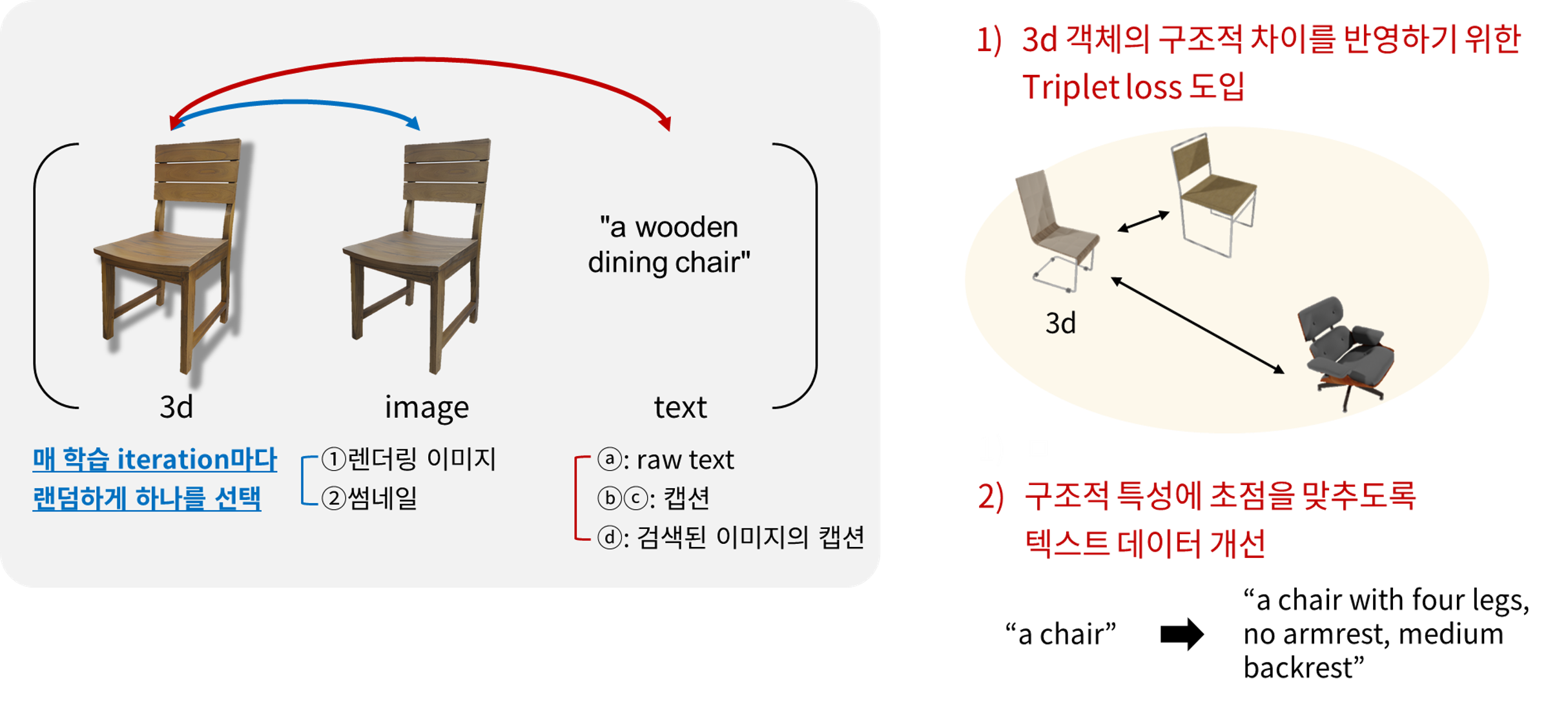
Structure-Aware Fine-Grained 3D Multimodal Embedding
Develop a structure-aware 3D multimodal embedding that maintains semantic alignment while capturing intra-class geometric variations, addressing the limitations of existing approaches that fail to differentiate fine-grained structural differences within the same category.
Details
Role
- Designed a geometry-aware intra-class hard negative sampling strategy to encourage the model to distinguish structurally different samples within the same semantic class.
- Built a GPT-based text generation pipeline that produces multi-view, part-level descriptions to ensure structural cues are reflected in the text modality.
- Proposed and implemented a joint learning framework combining multimodal contrastive loss (3D–text, 3D–image) with a structure-aware triplet loss applied on the 3D branch to enhance geometry-sensitive representation learning.
Results
- Improved FG3D chair fine-grained classification Top-1 accuracy by +2% compared to the OpenShape baseline.
 2024.01 – 2024.12
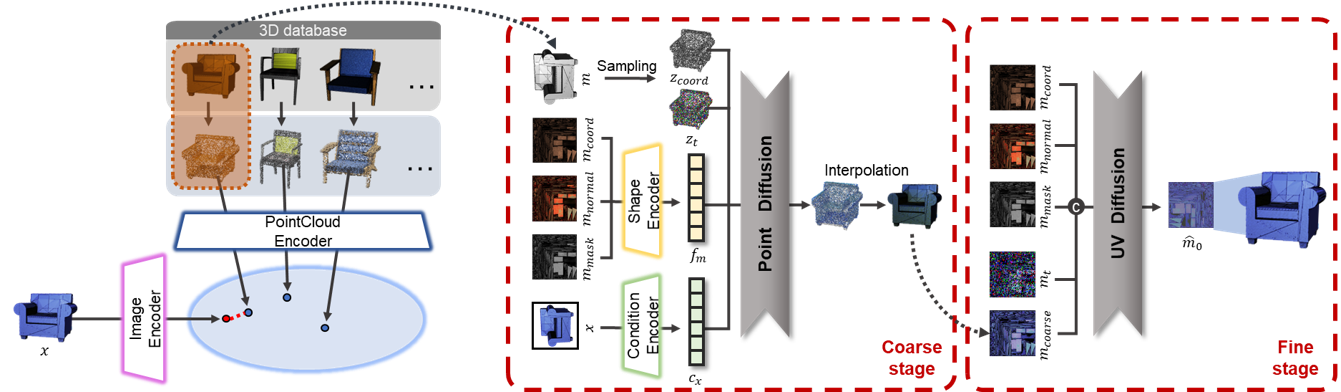
Retrieval-Augmented 3D Mesh Generation Pipeline
Address limitations of end-to-end image-to-3D generation models (slow inference and insufficient asset quality for industrial use) by building a retrieval-based approach that first finds the closest 3D mesh from a large-scale database using multimodal embeddings, then generates texture map conditioned on the retrieved mesh.
Details
Role
- Developed an image-to-3D retrieval pipeline using OpenShape multimodal embeddings to effectively match input images with the most similar 3D mesh assets.
- Evaluated multiple texture generation approaches, selected the best-performing model, and integrated it with the retrieval module to build a full end-to-end generation system.
Results
- 1 domestic conference paper, 1 international conference paper, and 1 domestic patent.
 2023.01 – 2023.12
Webtoon Generation Automation System
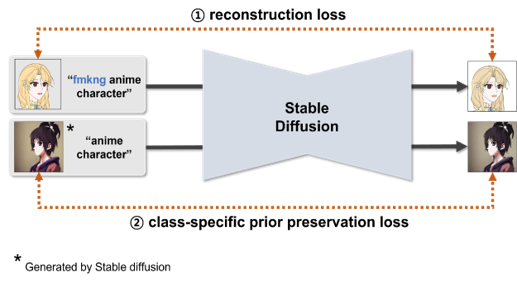
Develop a system enabling webtoon creators to generate character images based on prompts/images through generative models, including style-conditioned generation trained on a specific artist's drawing style.
Details
Role
- Fine-tuned Stable Diffusion 1.5 using a webtoon character dataset via DreamBooth to learn consistent artist styles.
- Integrated ControlNet to support pose, facial expression, and background editing.
- Developed key modules of a web-based creative workflow tool supporting conti → sketch and sketch → coloring pipelines.
Results
- Achieved +0.1 LPIPS improvement and +0.71 recall in character identity recognition compared to the baseline model.
- Technology showcased at the 2023 Bucheon International Comics Festival (BICOF).
- 1 domestic journal paper, 1 domestic conference paper, 1 international conference paper, and 1 domestic patent.
Contrastive Learning for Knowledge-Grounded Dialogue Generation
Improve the ability of knowledge-grounded dialogue models to distinguish relevant information from irrelevant knowledge using a contrastive learning approach.
Details
Role
- Built the experimental environment for contrastive learning and adversarial perturbation–based training.
- Supported benchmarking and ablation studies on the Wizard of Wikipedia dataset, including evaluation and comparative analysis against baseline models.
Results
- Achieved measurable improvement with +6% increase in KF1 over the baseline.
AI-Based Landmine Detection Model Development
Build a 5-class object detection model capable of identifying landmine type and location from Ground-Penetrating Radar (GPR) imagery to support real-world field detection and reduce manual inspection workload.
Details
Role
- Fine-tuned a Faster R-CNN object detection model using a custom GPR dataset.
- Designed preprocessing and augmentation strategies optimized for unique signal and texture characteristics in GPR imagery.
Results
- Successfully achieved the target recall score.